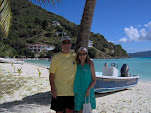
Linda and I finished our Great Loop adventure on August 20, 2010. The journey was the culmination of years of planning and dreaming. As we cruised through the Grand Haven channel that day, Linda said, "I could do that again! Not right now, not next year, but some time down the road." When the window opened at summer's end this year, we jumped out of it, leaving Grand Haven on September 17 to begin this great adventure again.
 We left for South Haven with friends and fellow State Farm agents, Ward and Jean Verseput, who purchased a new-to-them boat a few months earlier specifically for this trip. They named it "Dream Maker". It was an uneventful trip on Lake Michigan, and seas were calm. This was our first stay in South Haven, and we enjoyed it, especially the obligatory "mess of perch" at Clementine's. We left for Chicago the next morning and were surprised by visitors two different times--finches, who hitchhiked with us while fourteen miles off shore just short of Chicago. After resting with us, one of them flew off to join Dream Maker where it foraged for food for a time. We took a photo of our friends' boat while underway, and enjoyed seeing the Chicago skyline again as we approached it.


In Hammond Harbor, we lowered Dream Maker's radar arch, so it could clear the many bridges we would encounter on the rivers, then entered the Calumet River on the way to the Illinois. This first stretch is very industrial, busy with barges carrying coal, aggregates, and chemicals. We stayed a night at the free dock in Joliet along with four other boats doing the Loop.


Linda and I had to once again familiarize ourselves with the procedures for requesting bridge openings, locking through river locks, and requesting passing instructions from tow captains who talk to other boaters in shorthand, frequently with a Cajun accent. Remember, "one whistle" you move to the right, and "two whistles" you move to the left! Our locking experiences on the Illinois actually went quite well with one exception. When approaching our fifth lock, we had to follow a slow tow which, due to its length, had to be split up and locked through in two stages. We had to wait three and a half hours for our turn, anchoring in very skinny water with tree stumps and debris close off our port side. Fortunately, the river current kept us straight and out of trouble, and we had Dream Maker raft off our boat to make for the best use of space. Because of the delay, however, we couldn't clear the lock until after dark and had to move two miles downriver using our spotlight. Leading a small flotilla of three boats, we entered the marina's narrow, almost hidden, channel with the help of the harbormaster's flashlight guiding us in.

Cruising the river can be stressful, but more often it is interesting and beautiful. We spent nights tied to barges, saw deer, eagles, osprey, egrets, white pelicans and spectacular sunrises. Often we saw cattle drinking water in the shallows.


After travelling a few tiring days, we often stopped a while to recoup. We stayed at Grafton, Illinois, for example, where the Illinois meets the Mississippi. Linda and I biked a beautiful trail along the rivers and into the hills each of the three days we were there. We shared stories with our friends over dinner and drinks, walked the shops and flea markets, and generally gathered our strength for the next phase of our journey. Attached is a photo taken from our dock showing sun-drenched bluffs along the Mississippi at the spot the Illinois enters. Notice in the foreground the long poles on the floating break wall whose purpose is to allow for fluctuations in river levels.


To get to our first stop on the Mississippi, we had to clear two locks. We passed St. Louis which incredibly has no pleasure craft facilities, and tied up to Hoppie's Marina which consists of four flat-topped barges to which boaters can moor. Hoppie's is the only place on the Mississippi south of St. Louis where fuel is available until several hundred miles downstream. Fern Hopkins, co-owner of the marina with her husband, is a legend on the river. Everyday, she holds court at 4:30 under a canvas awning on one of her barges and tells boaters what to expect downstream relative to river currents, debris, and available anchorages. She has a large network of people, including barge captains, who keep her updated. With knowledge of the area and the people who ply the river, she is of immense help to those who get into trouble. She saved our bacon by giving us full use of her home office when we needed it seven years ago.


During our time on the river, the water was up, with currents running 5-6 mph. This was great for fuel economy and speed but meant we had to dodge a lot of debris and be extra careful around the large tows. The largest tow we saw pushed 42 barges! We had to power through strong whirlpools on some of the bends and were careful not to time our crossing when tows were nearby. (Though our boat is heavy, we were tossed around quite a bit in these whirlpools and wondered how smaller boats like the sailboat in the photo below could manage to get through.) Fortunately, we had installed an AIS (automatic identification system) prior to this trip, so we could see these tows on our chart plotter and call them by name when necessary for their passing instructions. After a long day of 112 miles, sometimes going north in order to go south, we rested with six other boats for the night in a beautiful little anchorage near Cape Girardeau, Missouri.


At daybreak, we left for the Ohio River where we, for the first time on this trip, moved against the current. After about 60 miles, we made a right turn into the Cumberland and to a wonderful full service marina called Green Turtle Bay. We stayed at GTB, a favorite of Great Loopers, for five days, biking, hiking, and enjoying the nearby town of Grand Rivers, Kentucky. If you ever get to visit this place, try the two pound pork chop at Patti's. They do provide doggy boxes!
 From GTB on Pickwick Lake, we moved through a cut which allowed us to get to Kentucky Lake and the Tennessee River. Traveling through this area we saw abandoned bridges, loading docks, and other structures left behind when the TVA dams created the lakes which flooded this area. These waters are now teaming with fish and fishermen, and homes which line their banks.


Though the lake and river levels are tightly controlled, flooding does occur, and many of the river front homes are built on stilts. During our trip, the water was at "winter pool" which appeared to be about five feet below standard depth. Lowering the pool allows for more water to enter the system in the spring. The photo below shows the low water, with docks and rafts on sand rather than water.
 After more locks and marinas, we stopped at Grand Harbor Marina at the beginning of the Tennessee-Tombigbee waterway. Using their courtesy car, the four of us visited Shiloh National Military Park, the site of one of the first major battles in the Western Theater of the Civil War. Of the approximately 110,000 troops involved in the two day battle, over 24,000 were killed, wounded, or missing. The battle was named after the Shiloh Methodist Church pictured below.

 From Grand Harbor, we entered the Tenn-Tom, a 234 mile waterway which connects the Tennessee River to the Black Warrior River system at Demopolis, Alabama. Constructed by the Army Corps of Engineers over twelve years, it was completed in 1984. It consists of ten locks and miles of man-made cuts. From Demopolis, the Tennessee-Black Warrior river system terminates in Mobile Alabama, providing a navigable system all the way to the Gulf. As an aside, most Loopers inaccurately, but by convention, call the entire stretch from the Tennessee River to Mobile, the Tenn-Tom. Below is a photo of one of the cuts as well as a couple of pics of some of the locks in this stretch. Note that Linda is holding us tight to the lock wall with a line around a floating bollard. Though not visible here, she is wearing a two way communication device which allow us to talk in normal tones while out of ear shot.


Marinas are becoming more and more scarce as we go south, but we stayed at a couple of interesting places. The Smithville Marina pictured below is a good example. It's a friendly place just above a lock and dam and boasts of colorful characters leading what appears to us as rather unconventional lives. It also houses a number of colorful boats, some of which are derelict, abandoned since damaged by a tornado four years ago. That tornado destroyed the town of Smithville itself and swept away the husband and wife owners of this marina. Their son now runs the place. A courtesy car is available!


Perfect Timing is now in Columbus, MS, a day's run from Smithville. We will return to it on October 28 after taking care of business and family at home.